The Life and Times of Hieronymus Bosch
Category: Kindle Store,Kindle eBooks,Arts & Photography
The Life and Times of Hieronymus Bosch Details
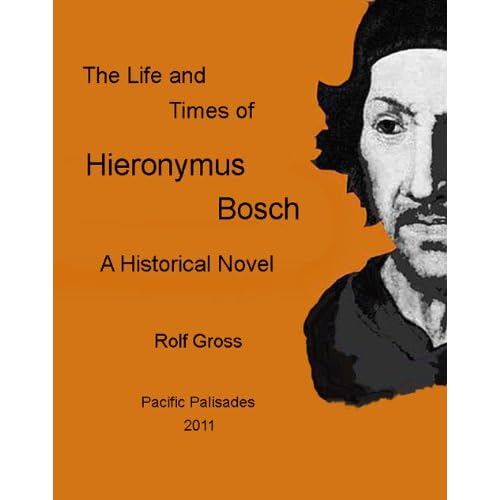
This historical novel is a reconstruction of the life and times of the Flemish painter Hieronymus Bosch (1415-1516) by reading the biographical information from his paintings. Until recently such an undertaking would have been impossible, we known preciously little about his life and his paintings are not dated. However, in the past 30 years Prof. P. Klein of the University of Hamburg has dated the wood panels of all but two of Bosch's paintings using dendrochronological techniques. Comparing the tree rings of a panel with calibrated samples, Klein was able to establish the earliest date on which the wood could have been painted. We suddenly had a scientifically determined chronology of Bosch's work. This encouraged me to make the experiment of taking Klein's data literally, read Bosch's biography from his paintings, and see how this would fit the historical events of his time. Anyone familiar with Bosch will realize that such a venture requires a certain amount of imaginative guessing. In several instances this led me to reinterpret a painting in ways different from previous interpretations or the present paradigm of the art-historians. To avoid bitter arguments, I cloaked my findings in the free form of a novel. Perhaps the largest shock of Klein's dating revolution was and still is, that Bosch could have painted his celebrated "Garden of Earthly Delights" between 1476 and 1470: His first triptych when he was only 18 or 20 years old? Other artists like Dürer, Masaccio, and Raphael painted some of their best work at this age, but Bosch's Garden is still considered one of his mature works. This challenged me to take a new look at the Garden. How could a young Bosch have had the knowledge of the complex iconography that he embedded in in this triptych? The answer is, he must have had an advisor learned in contemporary philosophy who spoke Hebrew. I did not have to invent him, he had already been discovered by Wilhelm Fraenger in 1948. His name was Jacob of Almaengien, a Jew whose baptism on command of Emperor Maximilian I plays a short but prominent role in the Chronicles of s'Hertogenbosch. Almaengien made his living as an itinerant magister who traveled from court to court teaching young princes. From his contributions to Bosch's Garden I claim that he was a student of the Italian neoplatonic philosopher Ficino. Jacob became Hieronymus' close friend whose image and contributions to Bosch's paintings can be traced down to Bosch's last major triptych "The Temptation of St. Anthony" of 1502. The ups and downs of this life-long friendship are the true subject of my novel. After Jacob's death, a year before his own death in 1516, Hieronymus described the events of their shared life in the four wings of a last fragmentary triptych, "Sicut Erat in Diebus Noë." Ironically, a dispute about the authenticity of these panels in Rotterdam brought Paul Klein into the fray of the Bosch experts, with all the consequences I have cursorily mentioned.Text size: 92 pages, 55 color illustrations


Reviews
The seamless blending of historical facts and fictionalized characters makes this a remarkable book. I rate it as one of the best historical novels I have ever read. If you are a Hieronymus Bosch fan, I recommend you read this book before you do any of your own research. The research done by the writer, with almost no biographical information, letters, or journals for reference must have made this a very intense job. I know because I also do research and understand the frustration of, for instance, conflicting or incomplete information. Bosch has always been a difficult artist to study. He is my favorite artist of the era and, although I never was able to decode his symbolism, I always was amazed by his strange creatures and the detail in his paintings. I did come away with questions about some of the characters and their personalities, how the writer decided how to portray Hieronymus' family for instance. The only thing I wish was that this book was available in hardcover as well as the kindle edition. I am in the process of collecting art books showing Bosch's paintings and drawings and would have liked to included it in my collection.