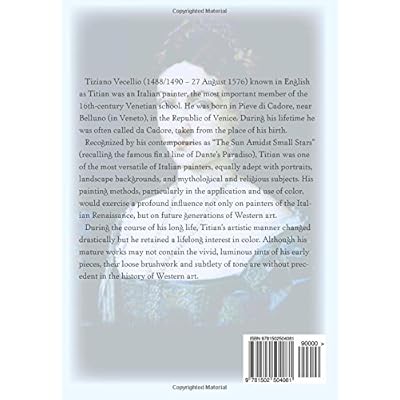
Titian: "Masterpieces in Colour" Book-I (Masterpieces in Colour series) (Volume 1)
Category: Books,Arts & Photography,Individual Artists
Titian: "Masterpieces in Colour" Book-I (Masterpieces in Colour series) (Volume 1) Details
About the Author It took Titian two years (1516–1518) to complete his Assunta, whose dynamic three-tier composition and color scheme established him as the preeminent painter north of Rome. During this period (1516–1530), which may be called the period of his mastery and maturity, the artist moved on from his early Giorgionesque style, undertook larger, more complex subjects and for the first time attempted a monumental style. Giorgione died in 1510 and Giovanni Bellini in 1516, leaving Titian unrivaled in the Venetian School. For sixty years he was to be the undisputed master of Venetian painting. In 1516, he completed for the high altar of the Basilica di Santa Maria Gloriosa dei Frari, his famous masterpiece, the Assumption of the Virgin, still in situ. This extraordinary piece of colorism, executed on a grand scale rarely before seen in Italy, created a sensation. The Signoria took note, and observed that Titian was neglecting his work in the hall of the great council, but in 1516 he succeeded his master Giovanni Bellini in receiving a pension from the Senate. Titian was now at the height of his fame, and towards 1521, following the production of a figure of St. Sebastian for the papal legate in Brescia (a work of which there are numerous replicas), purchasers pressed for his work. To this period belongs a more extraordinary work, The Death of St. Peter Martyr (1530), formerly in the Dominican Church of San Zanipolo, and destroyed by an Austrian shell in 1867. Only copies and engravings of this proto-Baroque picture remain; it combined extreme violence and a landscape, mostly consisting of a great tree, that pressed into the scene and seems to accentuate the drama in a way that looks forward to the Baroque. The artist simultaneously continued his series of small Madonnas which he treated amid beautiful landscapes in the manner of genre pictures or poetic pastorals, the Virgin with the Rabbit in The Louvre being the finished type of these pictures. Another work of the same period, also in the Louvre, is the Entombment. This was also the period of the three large and famous mythological scenes for the camerino of Alfonso d'Este in Ferrara, The Andrians and the Worship of Venus in the Museo del Prado, and the Bacchus and Ariadne (1520–23) in London, "perhaps the most brilliant productions of the neo-pagan culture or "Alexandrianism" of the Renaissance, many times imitated but never surpassed even by Rubens himself." Read more



Reviews